Educational video series for Pivot Into
A year-long YouTube series of 23 educational videos on career change — scripted, produced, and published as sole creator, using 2D animation, screencasts, AI avatars, and voiceovers, and built on multimedia learning principles.
Watch the series on the Pivot Into YouTube channelProject overview
Pivot Into is an independent educational brand I created on YouTube, focused on helping people navigate career change. Over the course of a year I scripted, produced, edited, and published 23 educational videos — handling the whole pipeline myself.
The series uses a mix of production methods — 2D animation, screencasts, AI avatars, and AI voiceovers — chosen per video to suit the content. Throughout, the videos are built on multimedia learning principles, so the production choices serve comprehension rather than decoration.
Key features & outcomes
- Created Pivot Into as an independent educational brand and published 23 videos over a year
- Scripted, produced, and edited every video as the sole creator
- Used 2D animation, screencasts, AI avatars, and AI voiceovers — matched to each video's content
- Applied multimedia learning principles (cognitive load, Mayer's coherence) to keep videos focused on comprehension
- Built a consistent format and visual identity across the series
Building an educational video series single-handedly means owning every role at once: the instructional designer who decides what to teach and how, the scriptwriter who makes it clear and engaging, the producer who builds the visuals, the editor who assembles it, and the publisher who ships it on a schedule.
The challenge was to do all of that consistently — 23 videos over a year — while keeping the production quality high and the teaching sound. Career-change content is also crowded and easy to make generic; the series had to be genuinely useful and have a recognisable identity.
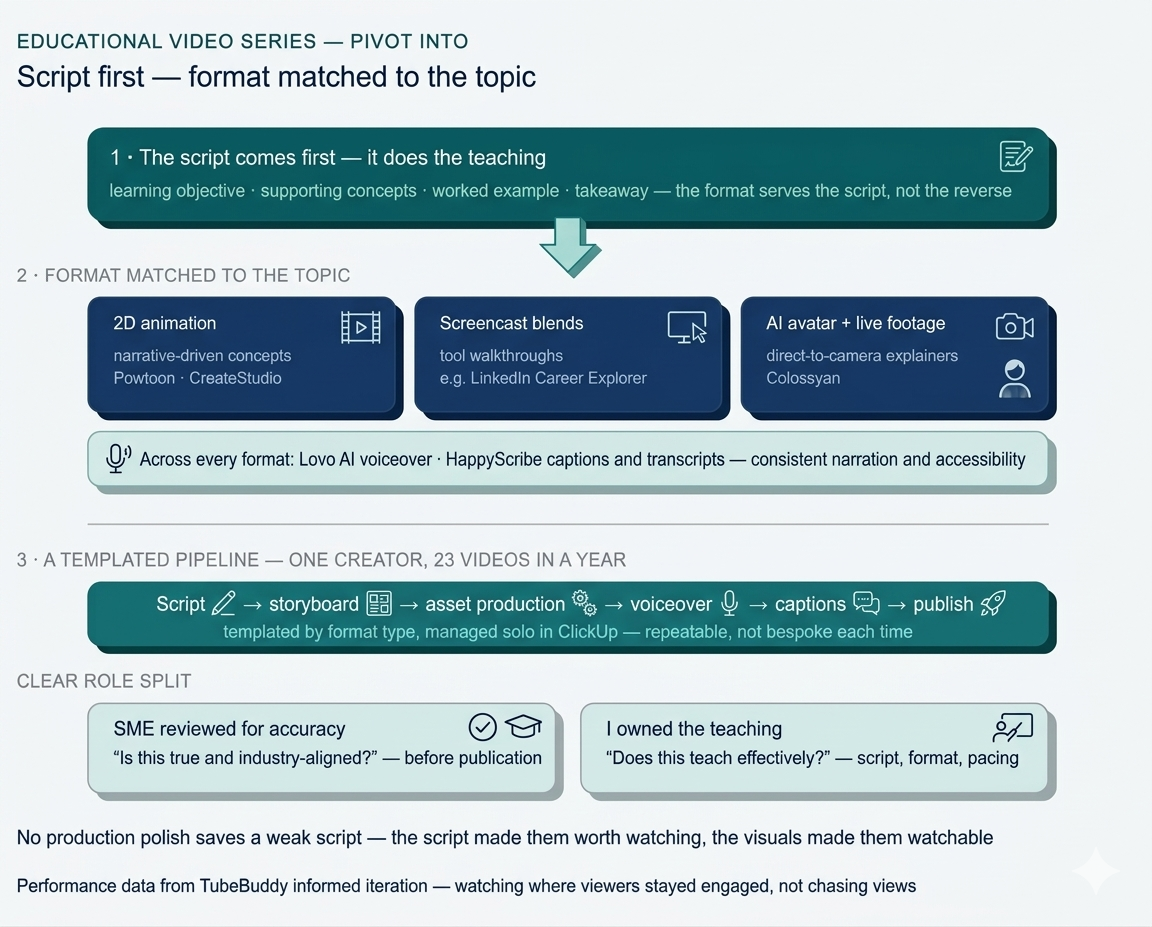
Script first. Every video started as a script. Getting the teaching right in words before producing anything visual kept the content clear and the production efficient — the visuals served the script, not the other way around.
Matched the format to the content. Some ideas are best shown as a screencast, some as 2D animation, some as a presenter-led piece using an AI avatar and voiceover. Choosing the production method per video meant each topic got the treatment that taught it best.
Built on multimedia learning principles. Cognitive load theory and Mayer's principles — especially coherence — guided the production. That meant cutting decorative elements that didn't aid understanding, pacing narration to match visuals, and keeping each video focused on one clear idea.
Kept a consistent identity. A recognisable format and visual style across all 23 videos made the series feel like a coherent body of work rather than a collection of one-offs.
The script is where the teaching happens. Producing visuals before the script is right wastes effort. Writing first kept every video clear and made the production phase faster.
AI tools made solo production viable. AI avatars and voiceovers let one person produce presenter-style content at a sustainable pace. The tools expanded what was possible to make alone, without a studio or a crew.
Principles keep production honest. Grounding the videos in multimedia learning principles stopped the production from drifting into decoration. Every visual choice had to earn its place by helping someone understand.