Blended course design for the WIPO Academy
From October 2025 to March 2026, I worked as the sole external instructional design consultant on a WIPO Academy course, turning expert content into an accessible Spanish-language learning experience for intellectual property office staff across Latin America and the Caribbean.
Project overview
The WIPO Academy commissioned a blended course on gender mainstreaming in intellectual property offices. Subject-matter experts supplied the core content through a coordinator at the WIPO Academy.
I turned that content into the complete course and managed the work from storyboarding and design through build, review, and final handover.
Key features & outcomes
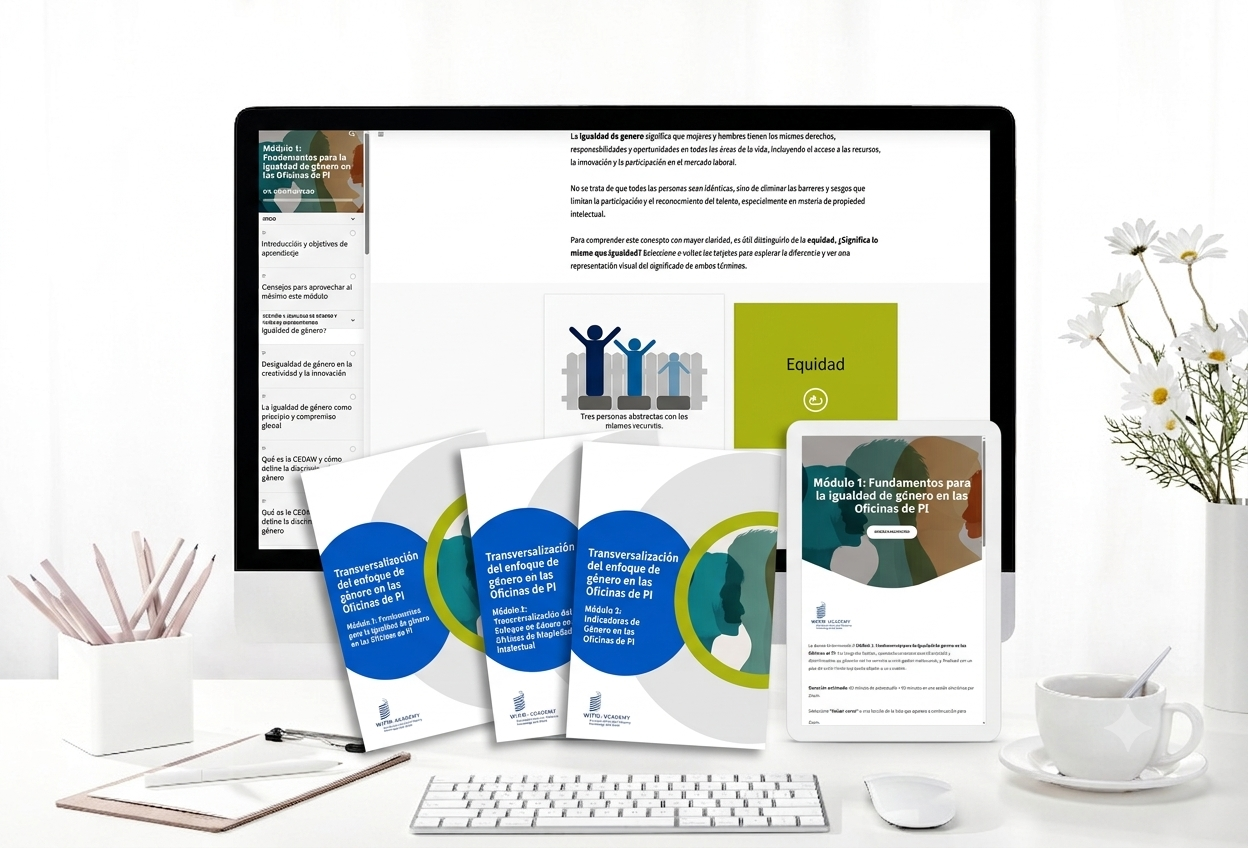
- Designed and built a three-module, SCORM-compliant Articulate Rise course in Spanish, totalling three hours of self-paced learning
- Created facilitator kits for three live Zoom sessions, totalling 3.5 hours of applied learning, with lesson plans, facilitator actions, slide guidance, and activity timings
- Produced screen-by-screen storyboards, three learner companion guides, a course glossary, assessments, rubrics, infographics, videos, and AI-generated imagery
- Designed and tested the course against WCAG 2.1 AA requirements from the storyboard stage, including a screen-reader-tested Rise template, customised Spanish interface labels, alt text, text equivalents, captions, and transcripts
- Delivered every contractual milestone on schedule through two rounds of WIPO and subject-matter expert review per phase
The course was intended for an experienced but diverse audience: staff working in intellectual property offices across Latin America and the Caribbean, in different institutional contexts and with varying levels of familiarity with gender mainstreaming.
It also had to meet WIPO and UN expectations for subject accuracy, cultural sensitivity, accessibility, and formal Spanish. Reviews involved the WIPO Academy, the Division for Latin America and the Caribbean, the Human Resources Management Division, and gender-and-IP subject-matter experts.
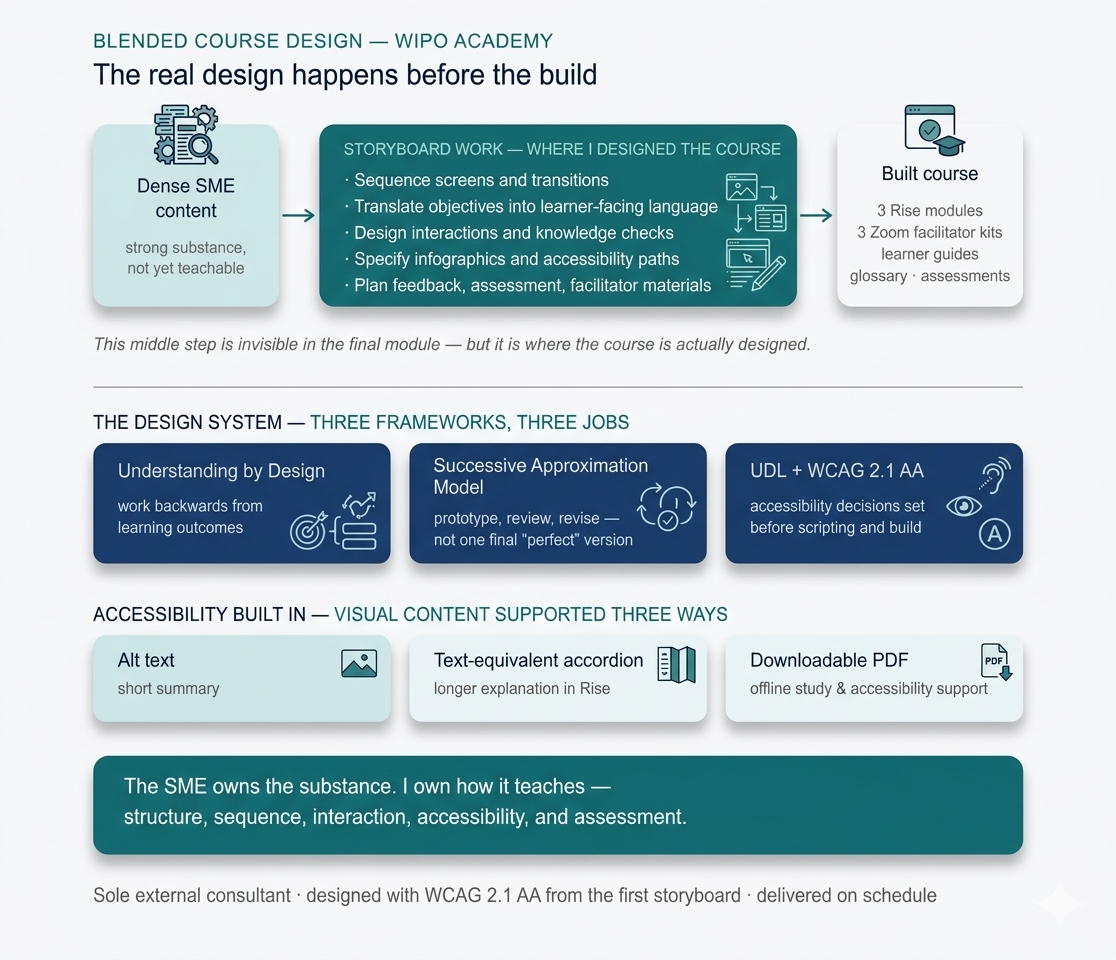
The source material was strong in substance but had not yet been structured for learning. As the sole external instructional design consultant, I needed to turn it into a coherent blended course and produce the learning materials without a separate production team.
Set the learning approach before writing. I used Understanding by Design to work backwards from the learning outcomes, the Successive Approximation Model to support rapid prototyping and iterative reviews, and Universal Design for Learning and WCAG 2.1 AA to guide accessibility decisions.
Turn expert content into digital learning. For each module, I converted the source document into a screen-by-screen production storyboard. This defined the learning sequence, transitions, interactions, feedback, assessments, and requirements for media and accessibility before the build began.
Build accessibility into the course architecture. Before scripting Module 1, I established a Rise template covering heading hierarchy, colour contrast, Spanish interface labels, and alt text conventions. Each infographic included concise alt text and a longer text equivalent, while every video included captions and a transcript. I also tested the template with a screen reader.
Write for a regional professional audience. I used formal Spanish — usted rather than tú — to match WIPO's institutional voice and the professionally experienced audience. I used clear sentences, front-loaded paragraphs, sentence-case headings, and examples from intellectual property offices across the region, including Brazil, Mexico, Peru, Chile, and Costa Rica.
Give each format a clear role. Rise introduced the concepts, frameworks, and examples. The Zoom sessions focused on applying them through recaps, Q&A, breakout-room casework, group discussion, and individual commitments. Each facilitator kit included a two-column lesson plan, slide guidance, suggested visuals, and timings so it could be delivered without a separate handover from me.
Most instructional design happens before the authoring tool. The finished Rise course is the visible result, but the key decisions about sequence, interaction, assessment, accessibility, and learner support were made while transforming the source content into storyboards.
Accessibility works best when it shapes the design. Establishing the accessibility requirements before writing and building reduced later revisions and made them part of the course structure rather than an additional QA step.
Solo delivery depends on strong systems. I created style guides, an alt text protocol, a Spanish Rise template, and an AI-assisted QA workflow to keep decisions consistent across the project. This supporting structure helped me manage a large set of deliverables while maintaining quality through multiple review rounds.